
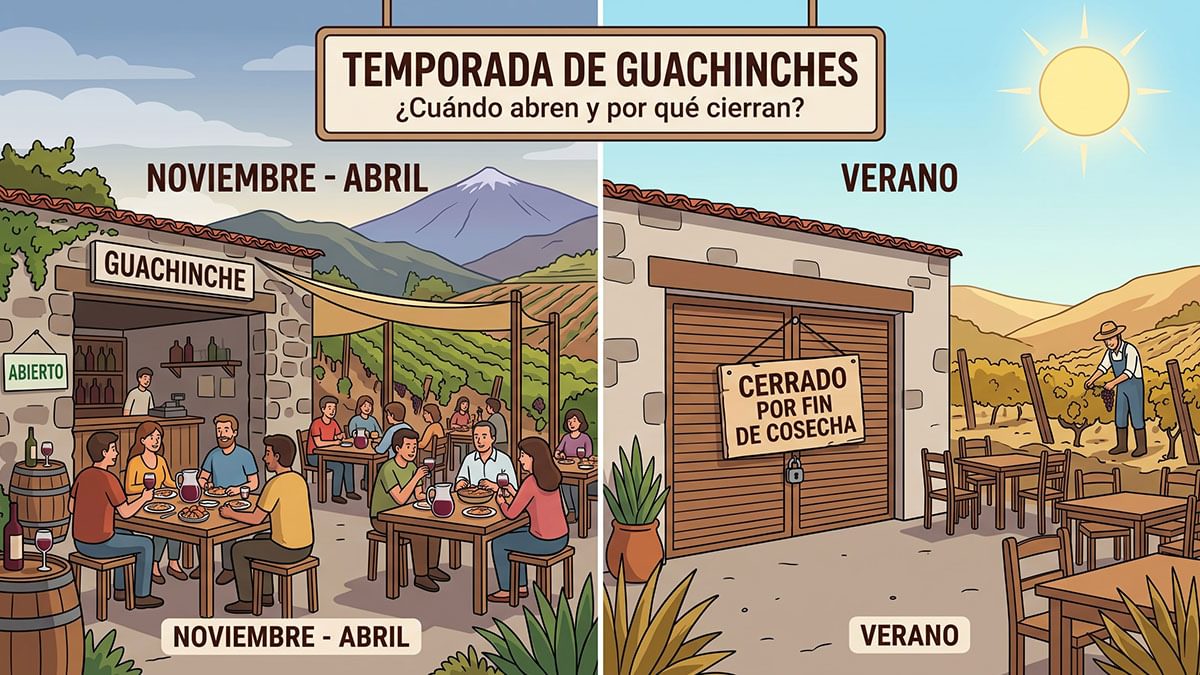
If you visit Tenerife in the middle of August and are looking for an authentic guachinche experience in the north of the island, you’ll likely find many garage doors closed. This causes a lot of confusion among visitors (and some residents), who wonder: Why are they closing just when there’s the most tourism?
The answer has nothing to do with the owner’s vacation, but rather with the very essence of what a guachinche is: the grape cycle . Below, we explain how the true guachinche season works and when is the best time to visit them.
San Andrés: The official starting gun
To understand the guachinche calendar, you have to look to the countryside. The grape harvest in Tenerife usually takes place between the end of August and September. After the grapes are picked, the must needs time to ferment and become wine.
When is that new wine ready? Tradition marks a key date on the Tenerife calendar: The eve of Saint Andrew, at the end of November (specifically the night of November 29).
This is the time of year when the new wine is “uncorked” and the vast majority of guachinches in the north (especially in the Acentejo area and the Orotava Valley) open their doors. Therefore, the winter and spring months (December to May) are the undisputed peak season for guachinches.
The golden rule: The 4-month rule
The existence of guachinches is protected and regulated by Canarian law (Decree 83/2013) to prevent unfair competition with traditional restaurants. This legislation imposes a very strict rule regarding their opening dates:
A guachinche can only remain open for a maximum of 4 months a year, or until the wine from its own harvest runs out.
This means that the lifespan of a guachinche each year depends entirely on the success of its vineyard. If a winegrower has a poor harvest and produces few liters, their guachinche could have to close in just a month and a half because they’ve run out of wine to sell. When the barrel is empty, the door closes.
So why do they close in the summer?
It’s simply a matter of math and regulation. If most guachinches open in November or December, by the time summer arrives (July and August), they have already far exceeded the legal limit of 4 months, or (more commonly) they have already drunk all their own homegrown wine.
Authentic guachinches are not allowed to buy bottled wine from other brands or bulk wine from third parties to remain open. Therefore, in summer, most winegrowers close their garages and return to the fields to prepare the land and vines for the imminent September harvest, restarting the cycle.
Are there any guachinches open in the summer?
Yes, it is possible to find open spaces, but two scenarios must be considered:
- Late-harvest or high-altitude guachinches: A few winegrowers, due to the altitude of their vineyards or the type of grape, open later (for example, in spring) and their 4-month season extends into early summer. However, they are a minority.
- Camouflaged Bodegones: As we saw in our article on Guachinches vs. Bodegones , many establishments you see open in August with “Guachinche” signs are, legally speaking, restaurants or bodegones. They have a conventional restaurant license, buy their wine from different wineries, and can be open 365 days a year. There’s nothing wrong with that (the food is spectacular!), but it’s important to know that they aren’t operating under the temporary regulations for traditional guachinches.